

By: Busani Bafana
Send to a friend
The details you provide on this page will not be used to send unsolicited email, and will not be sold to a 3rd party. See privacy policy.
[SALY, SENEGAL] A pest-resistant version of the black-eyed pea, a subspecies of the cowpea, is on track for commercial introduction, promising higher yields and claimed savings of up to US$1 billion on a crop that has found new popularity among African smallholders.
The cowpea, actually a bean, is rich in protein and is an important crop for both tackling malnutrition and adapting to climate change as it tolerates hot, dry conditions.
But infestation by the Maruca vitrata pod borer has cut the value of crops by up to US$300 million for smallholders in Africa, who produce nearly 5.2 million tonnes of the bean. The continent currently accounts for about 70 per cent of global production.
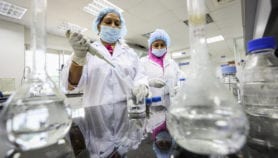
Now, scientists at the Institute for Agricultural Research (IAR) at Ahmadu Bello University, Nigeria, in collaboration with other institutes including the African Agricultural Technology Foundation, Kenya, have engineered an insect-resistant Bt (Bacillus thuringiensis) cowpea that they say could be on shelves in six years.
The cowpea — an ancient African crop — has been making a comeback in recent years, with increased yields seen across Africa, delegates heard this week (27 September–1 October) at the 5th World Cowpea Conference in Dakar, Senegal.
"The cowpea is emerging as one of the most important food legumes because of its early maturity and its fit as a niche crop in multiple cropping systems," said B. B. Singh, an international cowpea breeder and visiting scientist at Texas A&M University in the United States.
He noted that there has already been a six-fold increase in world cowpea production in the last few decades, a "quiet revolution that is greater in magnitude than that of cereals and all other pulses".
Christian Fatokun, a cowpea breeder at the International Institute of Tropical Agriculture (IITA), Nigeria, said that, as the crop is grown on a small scale by ill-resourced farmers, no commercial seed company will service this sector. And, because the cowpea is self-pollinating, companies also have little incentive to supply seeds.
The Bt cowpea will raise the status of the bean, claimed its developers. It could also generate up to US$1 billion by 2020 for farmers.
"Up until now, nobody in the scientific world was able to introduce resistance to this insect into cowpea," said Mohammad Faguji Ishiyaku, principal investigator of the Bt cowpea project and a researcher at the IAR.
"Our research will mean increased income by using less insecticide and increased productivity for areas growing cowpeas. Farmers will also have reduced exposure to harmful chemicals."
IITA agricultural economist, Ousmane Coulibaly, said surveys on cowpea in Nigeria, Benin, Mali and Burkina Faso have found that farmers are using a lot of expensive and sometimes harmful pesticides. In Nigeria — the largest producer and consumer of cowpea in Africa — net gains from not using pesticides could be about $500 million, he said.
More on Biotechnology