

By: A.A. Khan
Send to a friend
The details you provide on this page will not be used to send unsolicited email, and will not be sold to a 3rd party. See privacy policy.
[ISLAMABAD] Pakistani meteorologists have rejected claims that last year’s flood damage could have been reduced if they had collaborated with a major European forecasting centre.
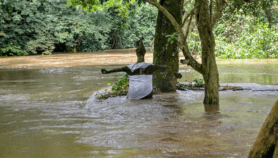
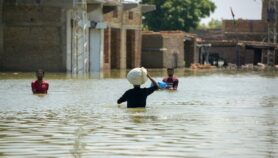
The floods, which occurred last July, killed just under 2,000 people, disrupted the lives of 20 million and damaged a fifth of the country.
A study — accepted for publication by Geophysical Research Letters — said that not only was the heavy rain predictable days in advance, from European data but, had this data been entered into appropriate models, it would have given up to ten days notice of the flooding.
"People don’t understand the powers of modern environmental prediction," said Peter Webster, lead author of the study and a professor of earth and atmospheric science at the Georgia Institute of Technology, United States.
His work was based on data that was available from the European Centre for Medium-Range Weather Forecasting (ECMWF) five days before the deluges began.
Webster’s study argues that the floods themselves could also have been predicted if this data had been fed into a model that took into account the local terrain.
The study blamed the lack of a cooperation between the EU centre and Pakistan. It also said that Pakistan’s own meteorological department failed to predict the downpours.
But Arif Mahmood, director-general of the meteorological department, told SciDev.Net: "We reject that theory. It is against the spirit of meteorological forecasting research. In weather-forecasting sciences it is easy to say something after the event."
He said that his department had also detected the weather patterns but their unprecedented nature (ten times the normal rainfall) meant that modelling, which is done based on past models, would not have yielded the appropriate level of flood prediction.
And Ajmal Shad, director of the flood forecasting division of the Pakistan meteorological department, told SciDev.Net: "The AGU study results are a concocted story".
"Both the EU consortium and the Pakistan Meteorological Department are members of the World Meteorological Organization (WMO) and the data could have been shared through that forum, given the objection that data was not shared because Pakistan was not member of that consortium."
He questioned why such important data was not conveyed to Pakistan even in the absence of a collaborating agreement, for humanitarian reasons. "I think they are responsible for large-scale human miseries in Pakistan. They should have shared the data with us on humanitarian grounds through WMO if they had detected something unusual."
Webster agreed that it "would have been good if the consortium had shared the data".
"But what would Pakistan have done with a telephone call saying that there would be large and catastrophic flooding? How could this information be transformed into massive evacuations of millions of people?
"We developed a system for Bangladesh using ECMWF data for flood prediction. It took a number of years to develop so that the people in vulnerable regions can be warned and get out of harm’s way.
"Such a system is possible for Pakistan but the government and the people must want it. If that is the case, ECMWF would provide, I am sure, data to help build such a system."
But Mahmood said: "To avoid such devastation in the future, we do not need any foreign weather consultancy but we need to construct new water reservoirs".
And Hazrat Mir, chief meteorologist at the flood forecasting division, told SciDev.Net: "Large scale human deaths in last year’s floods are not related to a lack of data or a warning system but were the direct consequence of public refusing to leave their houses in spite of our warnings — issued much ahead of the flooding in many parts of the country."
More on Water