

By: Eva Tallaksen
Send to a friend
The details you provide on this page will not be used to send unsolicited email, and will not be sold to a 3rd party. See privacy policy.
Researchers and students at three African universities will soon be able to use laboratory equipment at the Massachusetts Institute of Technology (MIT), United States, without having to leave their campuses.
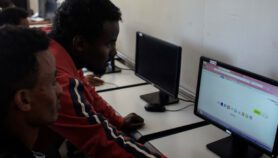
By accessing MIT’s ‘iLabs’ over the Internet, the staff and students will be able to manipulate laboratory equipment remotely using their computers and conduct experiments that are currently impossible because of the cost and restricted availability of necessary experiment.
The MIT Department of Electrical Engineering and Computer Science developed the iLabs concept in 1998. But while the iLabs are freely available to all, some universities in developing countries lack the computers and other resources needed to use them.
The Carnegie Corporation, a foundation aimed at advancing education in developing countries, has now stepped in with US$800,000 in funding to allow students at Makerere University (Uganda), University of Dar es Salaam (Tanzania) and Obafemi Awolowo University (Nigeria) to access the laboratories.
The project could have an important impact on the education of hundreds of students at the three universities.
“With the dearth of funds for the purchase of equipment for experimentation, the iLab project is an important intervention,” says L. O. Kehinde, coordinator of the iLab project at Obafemi Awolowo University.
“Not only will it afford better access by more students to relevant experiments, it certainly will also result in human and infrastructural development in partner African universities.”
 ‘Shake table’ used for research on earthquakes |
Working together, the African universities and MIT aim to develop new iLabs, that will benefit graduate and undergraduate courses in fields ranging from electrical engineering to physics.
The initiative includes an exchange programme in which staff and students from MIT and the African universities will visit each other for two-months to work on the creation of new iLabs.
“The project is likely to have multiplicative effects [in the form of] revamped curricula and the broader use of computers by students and teaching staff,” says Jesus del Alamo, co-principal investigator on the Africa project.
Del Alamo says that iLabs enable more students to do experiments by making them affordable and more accessible.
Today more than 3,000 students from four continents use the microelectronic iLab and interest in the technology is growing.
“Our success will be determined by the ability of other faculties to use the technology and infrastructure made available to develop their own online labs,” says del Alamo.
More on Digital divide