

By: Mićo Tatalović
Send to a friend
The details you provide on this page will not be used to send unsolicited email, and will not be sold to a 3rd party. See privacy policy.
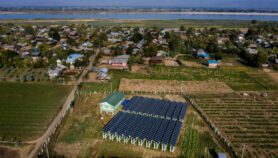
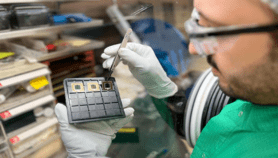
[HELSINKI] A flexible solar cell that could provide cheap energy for everyone has been awarded a prize worth €800,000 million (US$970,000).
The Millennium Technology Prize, which recognises "technological innovation that is significantly improving the quality of human life today and in the future", was awarded to inventor Michael Grätzel from the Lausanne Federal Polytechnic, Switzerland yesterday (9 June).
"Grätzel cells are likely to have an important role in low-cost, large-scale solutions for renewable energy," said Ainomaija Haarla, president of the Finland-based Technology Academy Foundation (TAF), which awards the prize, at the ceremony in Helsinki.
The other two laureates — awarded US$180,000 each — were Richard Friend, from the University of Cambridge, United Kingdom, who discovered cheap plastic electronics that can be used for more efficient solar cells; and Stephen Furber, from the UK-based University of Manchester, for his discovery of a simple, low-power microprocessor (the ARM microprocessor) that is now used in more than 90 per cent of mobile phones around the world.
"All of these [discoveries] have in a very significant way benefited the lives of millions … by promoting democracy through improving communication and by providing affordable sources of light," said Stig Gustavson, chairman of TAF.
"I find it a great disadvantage that our political leaders take so little interest in technology in today’s world where technology plays an ever increasing role."
Grätzel said his solar cells have many benefits and could, for example, soon be helping people in developing countries to connect to the Internet.
"I was in Tanzania last year and everyone has a mobile phone; but there’s no grid to charge them," he said.
Candidates for the award are sought from all over the world and all fields of technology, but this year’s laureates — and all past winners since the biennial award started in 2004 — are based in Western countries.
But the testing ground and applications of these new technologies take place in the developing world, V. S. Ramamurthy, a member of the 2010 international selection committee and chairman of Indian Institute of Technology Delhi, India, told SciDev.Net.
"For example, Grätzel is already working with people and organisations in developing countries, such as India, who are testing and implementing his solar cells."
Grätzel said that "production [of these new technologies] needs to be set up in developing countries so people can benefit from it there and not just be buying Western exported technology".
More on Energy