

By: Sue Coe
Send to a friend
The details you provide on this page will not be used to send unsolicited email, and will not be sold to a 3rd party. See privacy policy.
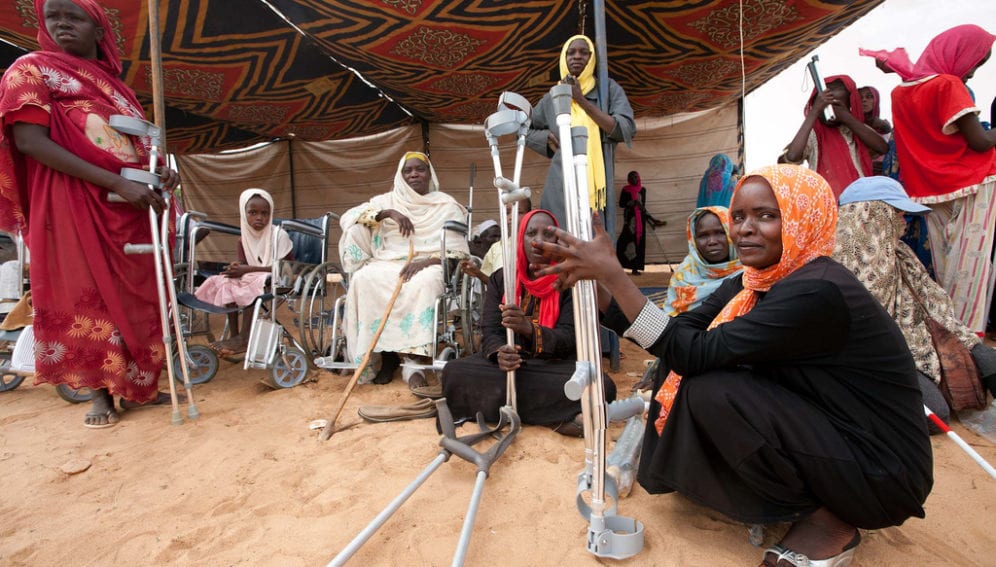
Disabled people are thought to comprise around a seventh of the population, so why are they routinely ignored in research, asks Sue Coe.
A recent review found that tangible health improvements can be achieved by focusing on housing improvements for the most impoverished. But did the researchers focus enough on disabled people's needs?
Based on my experience as a disability inclusion adviser, most researchers would answer "no". But why? Disabled people are estimated to comprise around 15 per cent of the world's population [1], yet are routinely ignored in research.
Much of this exclusion is the result of perceptions of disability, disabled people and their participation in society, rather than the realities and needs described by disabled people across the world.
It is common to hear excuses from researchers and funders for not including disabled people in research such as: "We need to sort out the problems of 'normal' [non-disabled] people first"; "There aren't many disabled people in the area where we work"; and "We don't 'do' disability — that's for specialist researchers". [2]
But disability is a normal part of every society, and many more people in communities across the world have impairments than is known or acknowledged. Research has shown that many people do not declare their impairments — or families hide those within them who have impairments — because of the stigma and discrimination associated with disability. [3]
A Paraguayan study included in the recent review examined the impact of improved light and ventilation on the reduction in Chagas disease. These improvements will also benefit people in certain impairment groups. For example, increased light could reduce domestic accidents among those with limited vision.
In considering disability, space and infrastructure around the house are also important. For instance, level paths with step-free access facilitate the mobility of those with physical impairments. Older people with reduced mobility and parents transporting young children will also benefit. Clear signs assist those with hearing impairments who rely more on signposting and those with limited vision. Decent lighting illuminates paths and signposts, and brings safety benefits to impoverished communities. These aren't just benefits for those with impairments. All these measures help to build healthy, stable environments for communities.
In researching housing improvements, researchers should visit homes to interview disabled people rather than relying on consultations in places that may have inadequate facilities for those with limited physical mobility. Appropriate communication provision for people with hearing and visual impairments is also critical. Identifying and interviewing all household members should also reveal the full diversity of issues within the household.
Science, research and development have enormous roles to play in improving disabled people's lives. Researchers must ask themselves whether their studies include consultations with disabled people as a matter of course.

Sue Coe has worked in international development for 25 years across Africa, Asia, Europe and the Middle East. Now a development and disability inclusion consultant, she previously worked for World Vision, Practical Action (formerly ITDG), VSO and Action on Hearing Loss (formerly RNID). Coe can be contacted at [email protected].
References
[1] WHO/World Bank World Report on Disability (WHO, 2011)
[2] Coe, S. and Wapling, L. Travelling together (World Vision UK, 2010)
[3] Innocenti Research Centre Promoting the Rights of Children with Disabilities (UNICEF, 2007)
More on Vulnerability