
Trees in the Sahel are disappearing fast
Flickr/Marco Bellucci
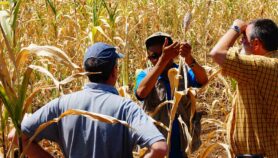
Trees throughout Africa's Sahel region — vital to peoples' livelihoods — are dying as a result of long-term drought linked to climate change, according to a study.
It found that one in six trees in the region has died since the 1950s, whilst a fifth of species has disappeared locally, because of rising temperatures and lower rainfall linked to climate change.
At some sites, average temperatures rose by 0.8 degrees Celsius and rainfall decreased by 48 per cent. Trees have shifted southward towards wetter areas.
This shift in the vegetation zones could have a severe impact on the lives of the Sahel's population warned Patrick Gonzalez, a climate change scientist from the University of California, Berkeley, in the United States, and lead author of the study, published online in the Journal of Arid Environments last week (17 December).
"People in the Sahel depend on trees for maintaining soil fertility and for firewood, hut poles, food and other essentials of life … so the loss of trees directly harms people's livelihoods," he told SciDev.Net.
The researchers combined aerial photographs captured between 1954 and 1989, field data from 2000–2002 relating to tree size and numbers and high-resolution satellite images from 2002 to show how tree distribution has changed across the region. Statistical analysis that compared this information with factors such as temperature, rainfall, human population and soil fertility showed that climate outweighed all other factors in driving this change, said Gonzalez.
Farmers in the region are already being forced to alter their techniques in response to changing climate. Many already practise natural regeneration — where they select, prune, and raise small trees to maturity in their fields — as an adaptation to climate change.
The study was partially funded by NASA (the National Aeronautics and Space Administration) and the US Geological Survey.
Link to abstract in Journal of Arid Environments
This article was modified 23 December 2011.
Journal of Arid Environments doi:10.1016/j.jaridenv.2011.11.001 (2011)
RD ( The Carbon Trap | United States of America )
3 January 2012
This was lazy journalism. The farmers aren't being 'forced' to grow trees, it's what they used to do before government got involved and stopped the process. They're just returning to old practices and environmentalists are taking advantage of the issue and blaming climate change.
Wasn't various African governments' policies that the government owned the trees responsible for removing natural trees and shrubs between crops? I've been reading the Sahel is experiencing a regrowth of vegetation. http://www.forbes.com/sites/jamestaylor/2011/12/14/is-global-warming-really-harming-africas-sahel-region/
Allan Savory ( Savory Institute & Africa Centre for Holistic Management | Zimbabwe )
3 January 2012
What a pity that US universities do not train people about how water cycles function in such seasonal rainfall environments in the U.S. and Africa. Seasonal rainfall rangelands in the US and throughout Africa exhibit anywhere up to 95% bare soil between grass plants. Such bare and generally capped soil leads to the available rainfall becoming less effective. Rain soaking in subsequently largely evaporates from the soil surface, or if rains are intense runs to flash flooding loss.
Two things lead to such high percentages of bare soil between plants in the US, Africa, Australia, China, Pakistan, Israel, etc etc.- too few large herbivores overgrazing plants while over-resting the land and/or fire. Both are standard treatments leading to less effective rainfall or desertification. We scientists as we know interpret data to fit our prevailing paradigms and so today it is fashion to attribute tree deaths through less effective rainfall to climate change. In reality it is desertification that is contributing to climate change which is now entering a typical feedback loop.
Fortunately people on four continents now are beginning to reverse desertification simply by making the available rainfall more effective using increased livestock and holistic planned grazing. Management needs to be holistic and can never be reductionist and such research, based on clearly flawed ground truthing of satellite imagery, is misleading and of limited use to practically solving the problems of current unnecessary cultural genocide, poverty and violence in a troubled region.
All comments are subject to approval and we reserve the right to edit comments containing inappropriate/unsuitable language. SciDev.Net holds copyright for all material posted on the website. Please see terms of use for further details.
All SciDev.Net material is free to reproduce providing that the source and author are appropriately credited. For further details see Creative Commons.
19 May 2013