

Send to a friend
The details you provide on this page will not be used to send unsolicited email, and will not be sold to a 3rd party. See privacy policy.
[JEDDAH/KARACHI/LONDON] A simple battery powered by potatoes may soon become a reality as scientists in developing countries move closer to commercialising their research.
The idea of batteries made out of vegetable matter sandwiched between zinc and copper plates is being trialled by several groups around the world, including Saudi Arabia and Sri Lanka.
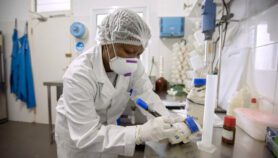
Suliman Abdalla, professor of physics at King Abdulaziz University, is developing a prototype "potato cell" battery which, he told SciDev.Net, could be commercially released within a year. In Sri Lanka, a similar battery powered by plantain pith has been developed by R. P. Wijesundera, physicist at the University of Kelaniya, who is now planning to commercialise it.
Both researchers said they were inspired by a 2010 paper by Israeli and US researchers, which showed that simple potato-based batteries could produce electricity in remote rural areas.
"The key contribution of our 2010 paper is in the introduction of the ‘make-it-yourself’ battery concept," said Alex Golberg, one of the paper’s co-authors and a fellow at the Harvard Medical School, United States.
He told SciDev.Net that the paper had demonstrated that an "affordable, cost-effective, low-power battery can be built in any place using already available materials".
Writing in the Journal of Renewable Sustainable Energy in November, Suliman Abdalla’s team demonstrated that potato-based batteries can be more than twice as efficient as a standard 1.5V battery — and 26 times cheaper.
"The current that could be produced is very sensitive to the food thickness," Abdalla told SciDev.Net, adding that 18mm slices of potato generated the most electric power.
The team used their patented device for testing food decay to test the electricity-generating capacity of different vegetables, which had shown that potatoes and garlic would give the best results.
"Millions of people in developing countries could benefit from such an abundant, cheap, and renewable source of energy," said Abdalla. He said the team has funding to develop a prototype for potential investors.
Commenting on the Saudi results, Golberg said the study had improved on the Israeli group’s original battery design and generated four times as much power, suggesting scope for further efficiency gains.
The Sri Lankan team has chosen to develop a vegetable-based battery powered by plantain pith.
"We did test the potato batteries first and they worked, but potato is a staple food in many countries and also it is not cheap for many people," Wijesundera said.
"Plantain pith is a cheap and environmental-friendly electrolytic material readily available in many parts of developing tropical countries… [so it] is a very good substitute for potato," he told SciDev.Net.
He said the team had successfully used a plantain-based battery to power two LED lights for 500 hours, potentially making them a low-cost energy supply for lighting and other power needs in rural households, and said the results are being prepared for publication and commercialisation.
"We are planning to fabricate plantain pith batteries to replace commercially available A, AA, AAA, and 9V batteries," Wijesundera said.
Golberg welcomed the adoption of the original Israeli research by developing country scientists.
"We decided not to patent this technology to avoid barriers to the wide-scale adaptation of our battery in [these] countries," he said.
"[Researchers there] are more familiar with the field conditions, local infrastructure and materials availability than anybody else. The fact that they perform this research makes these laboratories local contact points for potential local entrepreneurs and potential users."
Link to abstract in Journal of Renewable Sustainable Energy
Link to abstract of the 2010 study in Journal of renewable Sustainable Energy
References
Journal of Renewable Sustainable Energy 10.1063/1.3659289 (2011)
Journal of Renewable Sustainable Energy doi: 10.1063/1.3427222 (2010)
More on Cooperation