
Skip Navigation

Agriculture & Environment: Farming practices

News

  • Print
  • Comment
  • | Share

Fish and rice flourish together in paddies

Jan Piotrowski

16 November 2011 | EN | 中文

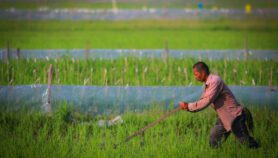
Farmer spreading fertiliser on rice field

Fish minimised the need for fertiliser

Flickr/IRRI Images

A traditional farming technique that cultivates rice and fish side-by-side could help small farmers earn more money from their crops and reduce the impact on the environment, according to a study.

When fish were introduced into flooded paddy fields, farmers were able to grow the same amount of grain as in conventional rice monocultures — but with more than two-thirds less pesticide and a quarter less fertiliser, found a six-year long study conducted in China.

These rice-fish co-cultures could lessen the environmental impact of agricultural chemicals and help make rice farming more profitable, said the study, published in the Proceedings of the National Academy of Science this week (14 November).

"In areas where land and water are limited for developing both rice and fish production, it is important to conduct RF [rice-fish co-culture]," Xin Chen, lead author of the study and a professor at Zhejiang University, China, told SciDev.Net. She added that the technique should be combined with modern techniques such as irrigation, and the use of machinery.

The fish used in the study were an indigenous carp species that is considered a delicacy, so farmers could sell them. They could also make large savings on fertilisers and pesticides, which typically represent 60–70 per cent of the total cost of rice production.

Fish significantly lower the risk of rice sheath blast disease and reduce the amount of weeds and harmful pests such as the rice planthopper. This invasive insect has the potential to devastate entire rice fields — an outbreak in Thailand last year destroyed four per cent of the country's harvest.

By regulating the amount of nitrogen in the ecosystem, the practice also minimised the need for applying fertiliser.

Rice plants also provided shade, thus keeping the water cool and allowing fish to remain active even during the hottest months. And insects attracted to the plants provided extra food for the fish.

Zainul Abedin, a farming systems specialist at the International Rice Research Institute, in the Philippines, said: "This is an extremely useful tool for poverty reduction and food security that can be used across tropical regions."

The practice can generate twice as much income compared with growing just rice, because of refinements of the thousand year-old technique, made possible by new research, he added. The findings reveal how the system works, hence making it possible to improve it.  

Paul Kiepe, the Africa Rice Center's representative for East and Southern Africa told SciDev.Net: "As fish catches are becoming smaller, [this approach] will be increasingly important for ensuring that food production provides people with enough protein".

But Kiepe stressed that many farmers do not have the right knowledge and tools to make the system work yet.

References

Proceedings of the National Academy of Science doi:10.1073/pnas.1111043108

Comments (8)

Mondal ( International Rice Research Institute | Bangladesh )

19 November 2011

Integration of rice scientists and fish scientists is very important to transfer this technology to the farmer's field. In Bangladesh there is a huge potentiality to transfer this technology.

Terry ( Red Plough International | Thailand )

23 November 2011

This is old news. Plus the article contradicts itself. If rice-fish systems are "traditional" farming systems how is it that farmers "don't have the right knowledge and tools"? Always these poor farmers are so lacking in "the right knowledge and tools" I wonder how they get through a day.

Jan Piotrowski ( United Kingdom )

23 November 2011

Although the technique is 'traditional' and has been used for centuries, only well-managed operations are profitable. It is not simply a case of adding fish and waiting; it requires an in-depth understanding of the relationship between the two species, which many farmers lack. Therefore in order to widely establish the technique, education is needed. With regard to tools, farmers need access to specialised machinery if they are to upscale the system and a reliable suppy of juvenile fish to stock their fields, which at the moment is
lacking.

MH ( Switzerland )

23 November 2011

After systematically despizing or destroying traditional ways, science now legitimates them. Panic times! It might be too late for many "innovative" old ways of doing things. Science! qu'en ton nom de crimes se sont commis...

rk sarkar ( India )

25 November 2011

This a good technology. Farmers of eastern India are gradually adopting this technique. Central Rice Research Institute is advocating this technique to rice farmers. Jan Piotrowski commented nicely. We have to adopt scientifically is to get maximum benefit from it.

hlawin ( Myanmar )

1 December 2011

It is perfect practice to harvest two food crops(fish and rice) from one source simultaneously. It has more pros rather than cons(almost nil if systematic). Policymakers should put more emphasis and energy to expand the technology and practice to farmers worldwide to maintain food security for over seven billion people. Hla Win

D.P.Sinhababu ( Central Rice Research Institute(CRRI), Cuttack, Orissa, India | India )

5 December 2011

With the diminishing natural resources(land , water), rice- fish technology will be the be-fitting and ecologically balanced complementary option for attaining food, nutrition , economic and employment security . This technology can be up scaled/down scaled according to situations and needs and can accommodate other profitable components like, vegetables, fruits, tuber crops, flowers, prawn, livestock, agro-forestry etc. Rice - fish models developed by Central Rice Research Institute, Cuttack for different rice ecologies, are being adopted by the farmers of eastern India. There is a need, to educate the farmers, to develop coherence among development organizations and to provide support by the policy makers to the farmers for successful adoption of the technology

Giuseppe Cattabriga ( Italy )

30 September 2012

Expériences de conversion d'une rizière conventionelle à biologique.
http://www.facebook.com/pages/Agriculture-des-eaux/344867215534232

Add your comment

This is your network: share your views on any of our articles by adding your comments.

You need to be signed in to post a comment or to email a consenting comment author. Please sign in or sign up.

All comments are subject to approval and we reserve the right to edit comments containing inappropriate/unsuitable language. SciDev.Net holds copyright for all material posted on the website. Please see terms of use for further details.

All SciDev.Net material is free to reproduce providing that the source and author are appropriately credited. For further details see Creative Commons.

Back to News
To the top